
Insights & Resources
Research, case studies, product updates, and guides to help you get the most out of EDTEX.

Latest Blogs

Why university timetable generation needs to be automated and digitised
University timetabling is one of academic administration's most time-consuming, conflict-prone burdens. Hundreds of courses, thousands of students, dozens of faculty constraints, and a finite set of rooms — all needing to align without a single clash. The institutions still doing this manually aren't just spending more time. They're accepting worse outcomes.
Universities automate timetable management by deploying dedicated scheduling software that integrates with their Student Information System (SIS), learning management system, and room booking platform. The software ingests data on courses, enrolments, faculty availability, and room capacities — then applies constraint-based algorithms to produce draft timetables that administrators review, adjust, and publish.
The result: a process that once took weeks is reduced to a matter of hours or days.
The typical university automation workflow
1. Data collection & validation
The scheduling system pulls course lists, student cohort sizes, room capacities, and faculty contracts from the institution's SIS and HR systems. Data quality checks flag missing or inconsistent records before scheduling begins.
2. Constraint definition
Scheduling managers configure hard constraints (e.g. no room double-booking, no faculty teaching two sessions simultaneously) and soft constraints (e.g. preferred teaching windows, minimal student travel between buildings).
3. Algorithm run
The constraint-satisfaction or optimisation engine generates one or more candidate timetables — typically in minutes for institutions with up to 5,000 courses.
4. Conflict review & manual adjustment
Administrators inspect a conflict report, resolve any soft-constraint violations, and apply exceptions — for example, accommodating a visiting professor's limited availability.
5. Publication & real-time updates
The final timetable is published to student portals, faculty calendars, and room booking systems simultaneously. Changes during term trigger automated notifications to all affected parties.
Common implementation challenge
Data quality is the most frequent obstacle. Scheduling software is only as accurate as the course, enrolment, and room data fed into it. Universities that invest in data governance before deployment report significantly smoother rollouts.
Integration with institutional systems
Modern scheduling platforms connect via API or middleware to the full stack of institutional systems — making the timetable a live, connected document rather than a static output produced once per term.
- Student Information Systems (Banner, PeopleSoft, Ellucian)
- Learning Management Systems (Moodle, Canvas, Blackboard)
- Room & resource booking systems (25Live, EMS, Rendezvous)
- Faculty HR and workload management tools
- Digital signage and campus wayfinding systems
Benefits reported by universities
Institutions that have automated timetable management consistently report the same outcomes — faster cycles, better room use, leaner teams, and near-zero student conflicts.
3–7 days
Timetabling cycle (down from 6–10 weeks)
15–25pp
Improvement in room utilisation
40–60%
Reduction in scheduling team FTE requirements
<1%
Student timetable clash rate in well-configured deployments
Changes also propagate near-instantly across all downstream systems — eliminating the lag between administrative decisions and student-facing updates that manual processes inevitably produce.
The bottom line
Timetable automation isn't just an operational upgrade — it's an institutional capability. When scheduling is fast, conflict-free, and integrated, academic teams spend less time managing exceptions and more time focused on programme quality. For universities still running the process manually, the question is no longer whether to automate, but how soon — and how well.

What is timetable scheduling automation?
Timetable scheduling automation is the use of algorithms, software, and artificial intelligence to automatically generate, manage, and optimise academic or organisational schedules — replacing manual timetabling by systematically assigning resources such as rooms, instructors, and time slots while respecting defined constraints to produce conflict-free, efficient timetables.
Before automation
Before automation, academic administrators spent weeks — sometimes months — manually assigning lectures to rooms, balancing faculty workloads, and checking for booking conflicts. A single change could cascade into dozens of knock-on adjustments across the entire schedule.
Timetable scheduling automation replaces this process with software that evaluates thousands of possible combinations in seconds — surfacing the most efficient, conflict-free arrangement from a solution space no human team could explore manually.
The real cost of manual timetabling
Timetabling errors directly affect student satisfaction scores, faculty retention, and space utilisation rates — making this far more than an administrative inconvenience. The downstream impact of a poorly constructed timetable touches every stakeholder in the institution.
Core components of scheduling automation
Constraint engine
Defines non-negotiable rules (hard constraints) and preferred outcomes (soft constraints) that govern schedule generation — e.g. no room double-booking, faculty teaching window preferences.
Optimisation algorithm
Searches the solution space using techniques such as integer linear programming, genetic algorithms, simulated annealing, or graph colouring to find the best possible schedule.
Resource database
Stores rooms, equipment capacities, faculty profiles, and course enrolment data as structured inputs for the scheduling engine.
Integration layer
Connects with Student Information Systems (SIS), HR platforms, and room booking tools so data stays synchronised across the institution in real time.
Conflict detection & reporting
Flags any remaining violations after generation so administrators can resolve edge cases manually — ensuring the final timetable meets all institutional requirements.
Why it matters
According to higher education research, timetabling errors directly affect student satisfaction scores, faculty retention, and space utilisation rates. The impact of automated scheduling is consistent and measurable across institutions of all sizes.
60–80% Reduction in timetabling cycle time
~0% Room conflicts in well-configured deployments
+20% Space utilisation improvement on average
Automated scheduling identifies underused slots and venues — improving space utilisation not just by eliminating conflicts, but by actively optimising how institutional resources are deployed across the academic calendar.
The bottom line
Timetable scheduling automation isn't a marginal improvement — it's a structural shift in how institutions manage one of their most operationally complex tasks. When done well, it removes weeks of administrative burden, protects student satisfaction, and turns timetabling from a source of institutional friction into a competitive operational advantage.
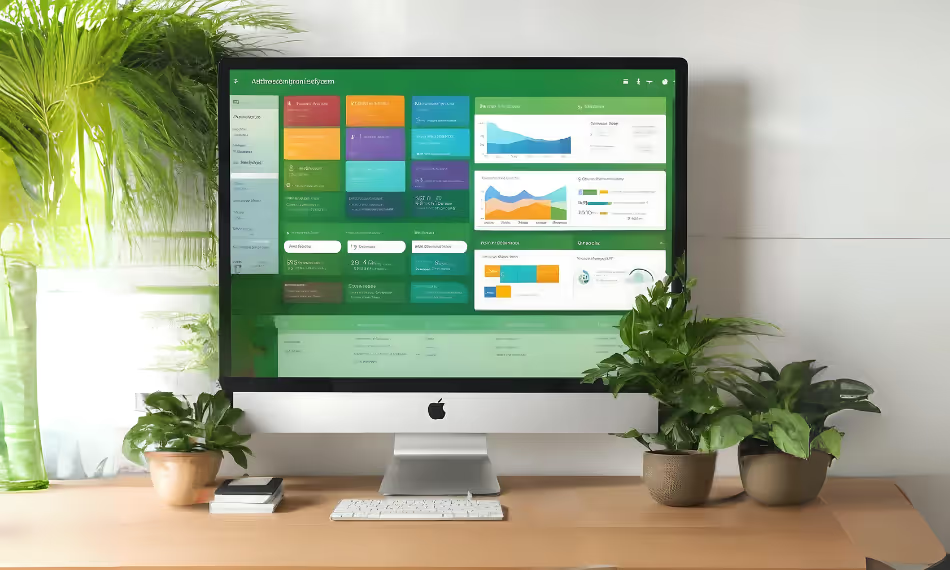
Why the University Timetable generation needs be Automated and Digitized?
University timetable scheduling refers to the process of creating schedules for classes, exams, and other university events. This task can be complex and time-consuming, but automation software can significantly streamline the process. Timetable scheduling automation and management software considers various factors for minimising clashes with a clash free scheduling approach
The various data inputs that are considered including:
- Course offerings
- Faculty availability
- Faculty Preferences
- Room availability
- Student preferences
- Student course registrations
- Active class time slots
- Active weekdays
- Holidays
Benefits of Automating University Timetable Scheduling
Automating the university timetable scheduling process offers several key benefits:
- Time and Effort Savings: Automation reduces the significant time and effort traditionally required to create schedules manually.
- Minimized Scheduling Conflicts: Automated systems help minimize scheduling conflicts by efficiently managing available resources.
- Increased Efficiency: Automation improves the overall efficiency of the scheduling process.
- Fairness and Equity: Data-driven scheduling ensures that schedules are fair and equitable, considering critical factors like faculty workload and student preferences.
Types of Scheduling Software
There are various types of software available for automating university timetable scheduling, ranging from simple spreadsheet-based solutions to sophisticated AI-driven systems. Each type has its strengths and weaknesses:
- Spreadsheet-Based Solutions: These can be prone to data errors and might not handle complex scheduling scenarios well.
- AI-Based Scheduling Systems: These Timetable Automation systems such a Registro Timetable Scheduler use advanced algorithms to generate optimal schedules and can handle more complex scheduling requirements.
Integration with University Systems
Modern Timetable Scheduling Automation softwares can integrate with other university ERP systems, such as:
- Student Registration Systems
- Course Management Systems
- Course Bidding Systems
This integration provides a seamless Timetable scheduling experience, Course Registration Experience for all stakeholders, ensuring that the entire Timetable scheduling process is Automated, Digitized with 100% visibility on clashes with provision for manual intervention for managing operational business scenarios on the ground.
Conclusion
Automating university timetable scheduling can greatly enhance the scheduling process, making it more efficient and effective. This automation allows universities to better manage their resources, reduce conflicts, and ensure that schedules are fair and meet the needs of all stakeholders, ultimately supporting the expansion of program offerings and improving overall university operations.





.png)
.png)
.png)