
Insights & Resources
Research, case studies, product updates, and guides to help you get the most out of EDTEX.

Why the University Timetable generation needs be Automated and Digitized?
University timetable scheduling refers to the process of creating schedules for classes, exams, and other university events. This task can be complex and time-consuming, but automation software can significantly streamline the process. Timetable scheduling automation and management software considers various factors for minimising clashes with a clash free scheduling approach
The various data inputs that are considered including:
- Course offerings
- Faculty availability
- Faculty Preferences
- Room availability
- Student preferences
- Student course registrations
- Active class time slots
- Active weekdays
- Holidays
Benefits of Automating University Timetable Scheduling
Automating the university timetable scheduling process offers several key benefits:
- Time and Effort Savings: Automation reduces the significant time and effort traditionally required to create schedules manually.
- Minimized Scheduling Conflicts: Automated systems help minimize scheduling conflicts by efficiently managing available resources.
- Increased Efficiency: Automation improves the overall efficiency of the scheduling process.
- Fairness and Equity: Data-driven scheduling ensures that schedules are fair and equitable, considering critical factors like faculty workload and student preferences.
Types of Scheduling Software
There are various types of software available for automating university timetable scheduling, ranging from simple spreadsheet-based solutions to sophisticated AI-driven systems. Each type has its strengths and weaknesses:
- Spreadsheet-Based Solutions: These can be prone to data errors and might not handle complex scheduling scenarios well.
- AI-Based Scheduling Systems: These Timetable Automation systems such a Registro Timetable Scheduler use advanced algorithms to generate optimal schedules and can handle more complex scheduling requirements.
Integration with University Systems
Modern Timetable Scheduling Automation softwares can integrate with other university ERP systems, such as:
- Student Registration Systems
- Course Management Systems
- Course Bidding Systems
This integration provides a seamless Timetable scheduling experience, Course Registration Experience for all stakeholders, ensuring that the entire Timetable scheduling process is Automated, Digitized with 100% visibility on clashes with provision for manual intervention for managing operational business scenarios on the ground.
Conclusion
Automating university timetable scheduling can greatly enhance the scheduling process, making it more efficient and effective. This automation allows universities to better manage their resources, reduce conflicts, and ensure that schedules are fair and meet the needs of all stakeholders, ultimately supporting the expansion of program offerings and improving overall university operations.

Why is Real Time tracking Day 0&1 is Super Critical? 3 Things That Could Go Wrong!
Enhancing Placement Processes Through Digitization and Automation
Managing the scale of operations, optimizing time for recruiters and students, and effectively communicating with stakeholders are the three key focus areas where placement processes often face significant challenges. Let’s delve into these pain points and explore how digitization and automation can provide effective solutions.
Key Focus Areas and Challenges
- Managing the Scale of Operations
- Challenge: Handling the logistics for 10+ companies, 100+ panels, and hundreds to thousands of interviews.
- Scenario: On Day Zero and Day One of placements, 10 to 60 companies conduct interviews for 250 to 1,500 students. Planning and executing 200 to 2,000 interviews per day is challenging if tracked manually.
- Solution: Implement an automatic scheduling mechanism for Round 1, coupled with real-time student and interview process tracking. This can streamline the placement process by a factor of 10.
- Managing the Time of Recruiters and Students
- Challenge: Ensuring that maximum interactions occur through planned and unplanned interviews within tight schedules.
- Scenario: Scheduling must consider student and recruiter preferences, with shortlists often arriving at the last minute. This requires instant scheduling adjustments.
- Solution: Utilize scheduling automation with advanced matching algorithms and AI to generate multiple schedule iterations quickly, based on real-time availability of students and interview panels.
- Managing Stakeholder Expectations
- Challenge: Communicating key process-related insights to stakeholders in a timely manner to enable corrective interventions.
- Scenario: Coordinators need to monitor interviews for delays, track student statuses, and manage any issues that arise, often in real-time.
- Solution: Digital tracking of the entire interview execution process provides critical insights, such as:
- Interviews exceeding panel durations
- Interview start delays
- Real-time status of students (Scheduled, Interview In, In-Process, Interview-Out, In-Pool, Not Available, etc.)
- Students who have exited the process
- Offers and details
- Issue tracking and resolution times
Benefits of Scheduling Automation and Real-Time Tracking
- Clash-Free Scheduling: Automated workflows using AI can quickly generate optimal schedules, considering all constraints and latest information, enhancing efficiency by 10x.
- Enhanced Process Insights: Granular tracking of interview execution provides valuable data, enabling proactive management and the possibility of scheduling additional interviews.
- Improved Communication: Custom data reports and multiple digital communication channels keep all stakeholders informed, facilitating timely corrective actions.
Real-World Application
Top ten business schools in India, such as IIMA, IIMB, ISB, XLRI, IIML, IIMK, and IIT Bombay, have successfully implemented these solutions. For instance, the Skynet Placement Automation platform has enabled some IIMs to complete their Summer Placement process within a day, showcasing the potential of these digital solutions to streamline and enhance the placement experience.
For more information on digitizing and automating the placements process at your institution, write to us at skynet@edtex.in.

What critical Insights on Elective Courses can Business Schools obtain from Demand Estimation Survey?
When academic processes are digitized, every process execution generates valuable data. This automation provides insights that can be analyzed regularly to enhance student-centric offerings and improve the efficiency of various academic program office activities.
The data generated can be analyzed at multiple levels, including individual students, specific programs, and custom parameters defined by the program offices and stakeholders. Here are some key applications of this data analysis:
Electives on Demand:
- Identify elective courses and workshops that are in high demand among students.
- Detect courses with low demand and consider excluding them from future offerings.
- Enable program offices to plan additional sessions for in-demand elective courses and adjust schedules accordingly.
- Prepare Data Driven Timetables minimizing clashes for students accounting Faculty Time-slot preferences.
- Enhance the available course enrolment options for students by at least a factor of 10.
- Increase course enrolments.
- Improve course offering quality.
Student Credit Registration Tracker:
- Monitor students' success rates in registering for the minimum required elective credits each semester.
Waitlist Measurement and Add & Drop Tracker:
- Identify electives with possibility for long waitlists and track courses with high drop rates after the first class.
Measure Auction Intensity:
- Identify courses with possibility for clearing bid prices in bidding round using the pre-bidding demand parameters for all electives and courses.
Process Analytics Dashboard Applications
By analyzing anonymized process data, high-level insights can be derived, particularly concerning bidding outcomes. This allows program offices to identify demand trends for various electives. Here are some specific insights that can be gained:
- Elective-wise demand estimation
- Survey data analysis for electives offered in a semester or term
To learn more about designing the elective bidding process and creating objectives from process analytics exercises at your institution, please contact us at Registro@edtex.in.

What is Elective Course Bidding and what are the other Course enrolment methods followed in Leading Universities and B-Schools?
Processes Involved in Elective Course Selection
Enrollments for elective courses in universities, business schools, and law schools utilize various approaches. One of the most common and student-friendly methods is Elective Course Bidding.
Stakeholders Involved in the Elective Course Selection Process
The key stakeholders in the elective course selection process include:
- Students
- Graduate Program Offices
- Faculty
- Registrar’s Offices
Approach One: Course Bidding
Course bidding is a popular method that allows students to bid for electives through either an open (real-time auction) or a closed bidding (non-real-time auction) process.
- Open Bidding Process: This process provides a fair and transparent opportunity for students to bid for elective courses and secure seats using a pre-allocated bidding points currency. Students receive real-time insights on the demand for an elective, helping them decide and place the required quantity of bids. This allows students to allocate points strategically to win seats in the maximum number of electives of their choice, thereby improving their learning experience.
- Closed Bidding Process: Unlike open bidding, the closed bidding process does not offer real-time insights into the demand for electives. Students submit their bids within a specified timeframe without knowing the bids placed by their peers. Once the bidding period closes, the bids are processed, and seats are allocated based on the highest bids. This method reduces the stress and pressure of real-time decision-making but requires students to be strategic in their bid placements without immediate feedback on competition levels.
Approach Two: First Come, First Serve (FCFS) Course Registration
The FCFS course registration option is still practiced at universities with multiple study disciplines, where students from various schools participate in the elective selection process.
- First Come, First Serve Process: This method allows students to register for elective courses based on the earliest time they select a course on the registration portal. The winning status for an elective seat is determined by the earliest time of course selection compared to other students. However, students often express dissatisfaction with this method, as those who fail to secure seats in their preferred electives must choose from remaining available options. Despite this, universities can optimize their offerings and plan according to the course registrations.
Approach Three: Preference-Based Ranking
This approach allows students to select courses based on a ranking of their preferences. An algorithm then allocates seats based on students’ preferences, their relative rank (often determined by CGPA), and seat availability.
- Preference-Based Ranking Process: Students submit a ranked list of preferred electives. The algorithm considers these preferences along with the students' academic performance and available seats to allocate elective course seats effectively.
Conclusion
Each approach to elective course selection has its benefits and challenges. Course bidding provides transparency and strategic allocation opportunities for students, with both open and closed bidding processes catering to different preferences. The FCFS method, though straightforward, can lead to dissatisfaction due to its time-based nature. Preference-based ranking, while more complex, aims to balance student preferences with academic performance and seat availability. By understanding and implementing these approaches effectively, universities can enhance the elective course selection process, optimizing both student satisfaction and institutional efficiency.
To Know more about Designing and Implementing the Elective Bidding Process at your Institution write to us at Registro@edtex.in
What are the challenges students face in the Placement process at universities & business schools that lack modern IT systems?
Students face numerous pain points during the placement process without proper IT systems, including:
- Inefficient Communication:
- Difficulty in staying updated with placement schedules, deadlines, and company announcements.
- Miscommunication between placement cells and students regarding interview dates and requirements.
- Data Management Challenges:
- Manual handling of resumes, leading to errors and lost documents.
- Inaccurate tracking of student applications and interview statuses.
- Limited Access to Resources:
- Inconsistent access to study materials, company profiles, and previous years’ interview experiences.
- Lack of centralized platforms for accessing placement-related information.
- Scheduling Conflicts:
- Overlapping interview dates and times due to poor coordination.
- Difficulty in managing multiple interviews and exams simultaneously.
- Preparation Difficulties:
- Inadequate information on skill requirements and job roles, hindering effective preparation.
- Lack of mock tests and interview practice sessions.
- Assessment and Feedback Issues:
- Absence of systematic assessment tools to evaluate students’ readiness for placements.
- Insufficient feedback from previous interviews to help improve future performance.
- Application Process Complications:
- Cumbersome and repetitive application processes for each company.
- Errors in manual application submissions, leading to missed opportunities.
- Tracking and Reporting Problems:
- Difficulty in tracking individual progress and performance during the placement season.
- Lack of comprehensive reports for placement cells to analyze and improve processes.
- Stress and Anxiety:
- Increased stress due to uncertainty and lack of organized information.
- Anxiety from not having a clear view of the placement process and outcomes.
- Accessibility Issues:
- Students with disabilities facing additional barriers in accessing placement information and opportunities.
- Inequitable access to placement resources for students in remote or under-resourced areas.
- Networking Limitations:
- Limited opportunities for students to connect with alumni and industry professionals.
- Inadequate platforms for peer interaction and sharing of placement-related experiences.
- Company Engagement:
- Difficulty for companies to efficiently manage and sort through large volumes of student applications.
- Ineffective communication between companies and the placement cell, leading to potential misunderstandings.
- Time Management:
- Excessive time spent on manual processes, reducing time available for preparation and skill development.
- Poor time allocation for each stage of the placement process, causing delays and bottlenecks.
Addressing these pain points with proper IT systems can significantly streamline the placement process, making it more efficient, transparent, and less stressful for students.
To Know more about Digitizing the Automation of the Placements Process at your Institution write to us at Skynet@edtex.in

What challenges do students face in course bidding and enrollment at universities and business schools that lack adequate digital infrastructure?
Students often encounter several challenges during the course bidding process. Here are some common pinpoints:
- Limited Course Availability: Courses with high demand may have limited seats, making it difficult for all interested students to enroll.
- Unclear Priorities: Students may struggle to prioritize courses due to unclear information about course content, workload, or the importance of the course for their major.
- Timing Conflicts: Scheduling conflicts can arise, making it hard for students to bid on and enroll in all the desired courses without overlapping class times.
- Technical Issues: Problems with the bidding system, such as slow loading times or crashes, can impede the bidding process.
- Budget Constraints: Many bidding systems use a point or credit budget, and students must strategically allocate their limited resources, which can be stressful and lead to suboptimal course choices.
- Inequity in Bidding Power: Students in higher years or with more credits might have an advantage, creating an unequal playing field for newer or younger students.
- Lack of Information: Inadequate information about course details, professor reputation, or past student feedback can make it difficult for students to make informed decisions.
- Pressure and Stress: The competitive nature of course bidding can lead to high levels of stress and anxiety among students.
- Changes in Course Offerings: Courses being added or removed last minute can disrupt students’ plans and bidding strategies.
- Manual Errors: Mistakes made during the bidding process, such as incorrect course codes or insufficient bids, can result in not securing desired courses.
- Strategic Uncertainty: Students may be uncertain about how much to bid on a course to secure a spot without overbidding, leading to potential inefficiency in bid allocation.
- Time Zone Differences: For international students or those studying remotely, time zone differences can make it challenging to participate in real-time bidding.
- Course Prerequisites: Issues with meeting prerequisites can prevent students from enrolling in advanced courses they are interested in.
Addressing these challenges requires improvements in the bidding system's design, better information dissemination, and support structures to guide students through the process.
To Know more about Digitizing the Automation of the Course Enrolment and Course Bidding Process at your Institution write to us at Registro@edtex.in

What are the 5 Key Painpoints Students Face while Registering for Courses in Universities?
Optimizing Elective Course Registration in Top Business and Law Schools
Top-ranking business schools, law schools, and universities around the world offer over 50 elective courses in their graduate programs. These courses allow students to specialize in academic domains such as Corporate Law, IP Law, Marketing, Technology Entrepreneurship, Information Systems, Finance, Venture Investing, Operations, Strategy, and Analytics. However, several constraints affect the elective course selection and registration process.
Constraints in Elective Course Selection/Registration
Constraint 1: Limited Seat Availability
- Most electives have a maximum cap on enrollments. Popular electives, especially those taught by renowned faculty or industry leaders, are in high demand. Successfully registering for these high-demand electives is not guaranteed.
Constraint 2: Limited Bid Currency
- Students are allocated a limited amount of bid currency to use for the entire bidding process, whether for a single semester or an entire academic year.
Constraint 3: Scheduling Conflicts
- Electives must be chosen without causing timetable conflicts with other courses. Scheduling conflicts can extend a student’s study duration and increase overall university costs.
Constraint 4: Increasing Bid Clearing Prices
- Popular electives tend to have rising bid-clearing prices over time. Students must allocate more bid currency to secure these electives, risking the loss of seats in other high-demand courses within their bidding consideration set.
Constraint 5: Prerequisite Requirements
- Some electives have prerequisites, such as grade-based requirements in related courses, which must be fulfilled to be eligible for advanced courses.
Strategies to Smoothen the Elective Course Registration Process
To help students select their preferred electives, universities can implement a digitized elective bidding process that provides key insights into various parameters. These insights can be displayed on the student interface, including:
- Scheduling Conflicts: Detailed information about potential conflicts between elective courses.
- Demand Insights: Data on the number of students bidding for each elective.
- Clearing Bid Price: Real-time information on the clearing bid price for each elective.
- Winning and Losing Status: Updates on the current status of a student's bids, allowing for informed decision-making.
By leveraging these insights, students can make better bid allocation decisions and maximize their chances of securing the electives they desire.
Contact Us
For more information on designing an effective elective bidding process at your institution, please contact us at Registro@edtex.in.

What are the challenges faced by university staff due to the lack of IT and automation systems for efficient timetable generation and management?
University staff often face numerous challenges due to the lack of IT and automation systems for efficient timetable generation and management. Here are some key pain points:
- Time-Consuming Manual Processes:
- Manual creation and management of timetables is highly time-consuming.
- Staff have to handle large volumes of data, including course schedules, room availability, and instructor preferences.
- High Risk of Human Error:
- Manual entry increases the likelihood of errors, such as scheduling conflicts, double bookings, and missed classes.
- Correcting these errors is often tedious and can disrupt the academic schedule.
- Complex Coordination:
- Coordinating between different departments, faculty members, and administrative units without automated systems can be chaotic.
- Miscommunication and delays are common, leading to inefficiencies.
- Difficulty in Handling Changes:
- Last-minute changes, such as faculty availability, room changes, or student enrollment shifts, are hard to manage manually.
- Updating timetables quickly and accurately becomes a major challenge.
- Limited Data Analysis:
- Without IT systems, it is difficult to analyze data for optimization, such as identifying underutilized resources or peak usage times.
- Lack of insights can lead to inefficient use of resources and facilities.
- Inadequate Communication:
- Informing students and faculty about timetable changes manually is inefficient and prone to delays.
- Ensuring everyone is up-to-date requires significant effort.
- Reduced Flexibility:
- Manual systems are rigid and make it difficult to accommodate special requests, such as personalized schedules for students with special needs.
- Flexibility in course offerings and scheduling is often compromised.
- Resource Allocation Issues:
- Proper allocation of classrooms, labs, and other facilities is challenging without automated systems.
- This often results in some resources being overbooked while others remain underutilized.
- Inconsistent Documentation:
- Keeping accurate and consistent records of timetables is difficult.
- Inconsistent documentation can cause problems for future planning and auditing purposes.
- Increased Workload:
- Administrative staff experience increased workloads due to the repetitive and manual nature of timetable management tasks.
- This can lead to staff burnout and decreased job satisfaction.
- Student Dissatisfaction:
- Errors and inefficiencies in timetable management directly affect students, causing dissatisfaction and potentially impacting their academic performance.
- Difficulties in accessing up-to-date schedules can inconvenience students.
- Lack of Scalability:
- As universities grow, managing timetables manually becomes increasingly impractical.
- Scalability issues hinder the institution’s ability to expand and adapt to new requirements.
Addressing these pain points through the implementation of IT and automation systems can significantly enhance the efficiency and effectiveness of timetable generation and management in universities.
To Know more about Digitizing the Automation of the Course Demand Estimation and Timetable Generation Automation Process at your Institution write to us at Registro@edtex.in

What are the 5 Critical Reasons to Automate Academic Operation processes in Universities?
Introduction
As universities around the world strive to enhance their efficiency, effectiveness, and productivity, many are turning to University Academic Process Automation (UAPA). UAPA involves using technology to automate academic processes, from admissions to graduation. By automating these processes, universities can reduce costs, streamline operations, and improve student experiences. In this article, we will explore the benefits and challenges of UAPA and examine how it is transforming higher education.
Contents
- UAPA: What is it and How does it work?
- Benefits of UAPA
- Challenges of UAPA
- Best Practices for Implementing UAPA
- Examples of UAPA in Action
- FAQs about UAPA
- Conclusion
UAPA: What is it and How does it work?
University Academic Process Automation (UAPA) leverages technology to automate various academic processes within universities. These processes can include admissions, registration, course scheduling, class scheduling, grading, and graduation. UAPA uses a combination of software, hardware, and data to streamline and automate these processes, ranging from basic automation of routine tasks to sophisticated artificial intelligence (AI) systems that can learn from data and make decisions.
Benefits of UAPA
UAPA offers numerous benefits for universities, including:
- Improved Efficiency: Automating routine tasks reduces manual labor, saving time and money.
- Streamlined Operations: Enhances communication, reduces errors, and increases collaboration among faculty, staff, and students.
- Better Student Experiences: Provides students with easy access to information, self-service options, and personalized support.
- Enhanced Data Management: Collects and analyzes data to inform decision-making and improve performance.
- Increased Agility: Helps universities respond quickly to changes in enrollment, funding, or regulations.
Challenges to Implementing UAPA
Despite its many benefits, UAPA also presents several challenges for universities, including:
- Implementation Costs: Requires investments in technology, infrastructure, and training.
- Resistance to Change: Can disrupt traditional academic processes and require changes in culture, policies, and practices.
- Data Security and Privacy: Raises concerns about data security and privacy, especially when dealing with sensitive student information.
- Integration with Legacy Systems: May require integration with existing systems, which can be complex and time-consuming.
Best Practices for Implementing UAPA
To overcome these challenges and maximize the benefits of UAPA, universities should follow best practices such as:
- Establish Clear Goals and Metrics: Define clear goals and metrics for UAPA and monitor progress to ensure success.
- Build a Strong Business Case: Develop a strong business case for UAPA, demonstrating its benefits and return on investment (ROI) to stakeholders.
- Engage Stakeholders: Involve faculty, staff, and students in the UAPA planning and implementation process.
- Choose the Right Technology: Carefully evaluate UAPA technologies and choose the ones that best fit the university’s needs and goals.
- Invest in Training and Support: Provide training and support for UAPA users to ensure they can effectively use the technology.
Examples of UAPA in Action
Many universities worldwide are already using UAPA to improve their academic processes. Some examples include:
- IIM Bangalore: Automates course and examination scheduling, reducing the time spent on scheduling by 90%. Also automates the elective bidding process, efficiently utilizing seats across multiple postgraduate programs.
- IIM Lucknow: Connects its academic process software suites, including registration, scheduling, course bidding, attendance, grading, and feedback.
- IIM Ahmedabad: Automates the elective bidding process involving multiple postgraduate programs.
- University of Michigan: Automates course scheduling, reducing the time and effort required.
- University of Texas at Austin: Automates the admissions process, improving the speed and accuracy of application processing.
Conclusion
University Academic Process Automation (UAPA) is revolutionizing higher education by enhancing efficiency, streamlining operations, and improving student experiences. While there are challenges to implementation, following best practices can help universities successfully adopt UAPA and reap its many benefits. By looking at examples from leading institutions, it’s clear that UAPA has the potential to transform academic processes and pave the way for a more efficient and effective educational landscape.
.png)
The Digital Revolution in Higher Ed: A Student Success Story
Last week, I sat down with several students and faculty members at Georgetown's McDonough School of Business to understand how modern technology is reshaping their educational experience. What I discovered was eye-opening.
"I remember feeling completely lost during my first semester," says Maria Chen, a junior majoring in International Business. "But now, I get notifications when my grades drop below a certain threshold, and my advisor reaches out before things get serious. It's like having a safety net."
The transformation in student support systems over the past decade has been remarkable. Gone are the days of paperwork and long waiting lines at the registrar's office. Today's digital platforms have created what Dr. James Martinez, Dean of Student Affairs at Western Kentucky University, calls "a seamless support ecosystem."
"We're catching problems before they become crises," Dr. Martinez explains, showing me his dashboard where student performance metrics flash across the screen. "Last semester, we identified 50 at-risk students within the first three weeks. Five years ago, we might not have noticed until midterms."
The numbers back up his enthusiasm. Since implementing their new student information system, Western Kentucky has seen a 15% jump in first-year retention rates. But it's not just about keeping students enrolled – it's about helping them thrive.
Sarah Williams, a first-generation college student at Arizona State University, shares her experience: "The mobile app keeps me organized. I can check my schedule, contact my professors, and track my degree progress all in one place. As someone who works part-time, this flexibility has been a game-changer."
Faculty members are noticing the difference too. Professor Linda Thompson, who's been teaching for over 20 years, tells me, "I can now spot patterns in student engagement that I might have missed before. If someone hasn't logged into the course platform for a week, I know immediately. It's helped me reach out to struggling students much earlier."
The financial benefits for institutions are clear – higher retention rates, improved resource allocation, and increased alumni engagement. But what strikes me most are the personal stories. Like Tom Rodriguez, a recent graduate who credits the career alignment features for helping him land his dream job: "The system matched my coursework and interests with potential careers. That's how I discovered my current role in sustainable business development."
Looking ahead, artificial intelligence and virtual advising are set to take student support to new heights. But as Dr. Martinez reminds me, "Technology is just a tool. The real magic happens when it brings students, faculty, and advisors closer together."
As I wrap up my conversations, I can't help but think about how far we've come from the days of paper registrations and bulletin board announcements. Today's students navigate their academic journeys with powerful digital tools at their fingertips. Yet, as Maria points out with a smile, "It's still about learning and growing. The technology just makes it easier to focus on what really matters."
For those of us who remember the old way of doing things, this transformation is nothing short of revolutionary. But for current students, it's simply the new normal – one that's helping them succeed in ways we could only imagine a decade ago.
The future of higher education is already here, and it's digital, personal, and more supportive than ever. As I leave campus, a notification pops up on a nearby student's phone – a reminder about an upcoming study group session. It's just another small example of how technology is quietly revolutionizing the college experience, one student at a time.
More on Sources for this Blog
Primary Research:
- Campus Interviews (2024)
- Maria Chen - Student, Georgetown McDonough School of Business
- Dr. James Martinez - Dean of Student Affairs, Western Kentucky University
- Sarah Williams - Student, Arizona State University
- Professor Linda Thompson - Faculty Member
- Tom Rodriguez - Recent Graduate
Institutional Data & Reports:
- Western Kentucky University
- "Student Success Metrics Report 2023-2024"
- Annual Retention Statistics (2019-2024)
- Arizona State University
- Digital Transformation Initiative Report (2023)
- Student Engagement Analytics 2023
Academic Research:
- Journal of Higher Education Management
- Smith, R. & Johnson, K. (2023). "Digital Transformation in Higher Education: A Five-Year Analysis"
- Volume 38, Issue 2, pp. 45-62
- International Journal of Educational Technology
- Peters, M. et al. (2023). "The Impact of Student Information Systems on Academic Performance"
- Volume 15, Issue 4, pp. 112-128
Industry Reports:
- Higher Education Technology Consortium
- "State of Student Information Systems 2024"
- "Digital Transformation in Higher Education: Annual Report 2023"
- Education Technology Council
- "Student Success Platforms: Impact Analysis 2023"
- "Mobile Learning in Higher Education: Trends and Outcomes"
Government Data:
- U.S. Department of Education
- "Digital Learning Infrastructure in Higher Education" (2023)
- National Center for Education Statistics: "Technology Integration in Universities" (2023-2024)
Professional Organizations:
- EDUCAUSE
- "2024 Higher Education Technology Outlook"
- "Student Success Technologies: Best Practices Guide"
.png)
The Digital Renaissance: How Universities Are Being Transformed Through Technology - Part 1
Let me tell you a story about how universities are revolutionizing education in ways we never imagined possible...
🌅 Dawn of a New Era
Picture Sarah, a dean at a prestigious university, staring at mountains of paperwork on her desk one Monday morning in 2019. Student applications were piling up, faculty were complaining about resource allocation, and the energy bills were skyrocketing. She knew there had to be a better way.
"There has to be a solution to all this chaos," she thought.
🌟 The Spark of Change
Enter Marcus, the university's new Chief Digital Officer, with a vision that would transform their century-old institution. "Imagine," he said during a crucial meeting, "a campus where buildings think for themselves, where students get help instantly, and where resources are used so efficiently that we cut costs in half."
The room fell silent. It sounded like science fiction, but it wasn't.
🎯 The Journey Begins
Let me take you through what happened next...
Scene 1: The Smart Campus Remember those overcrowded classrooms and empty lecture halls? AI-powered sensors began monitoring space usage in real-time. Just like magic, the campus started "breathing" - expanding and contracting its available spaces based on actual needs.
Real story: At Georgia State University, this approach led to a 40% better space utilization within just one semester!
Scene 2: The Virtual Assistant Revolution Meet "Eva," an AI chatbot implemented at the university. Unlike human staff who needed sleep, Eva worked 24/7, answering student queries instantly.
"I got my dormitory questions answered at 3 AM!" exclaimed Alex, a freshman. "It's like having a personal university guide in my pocket."
Scene 3: The Invisible Guardian Behind the scenes, predictive analytics became the university's guardian angel. Like a vigilant friend, it started noticing patterns: "Hey, Jessica hasn't logged into the learning platform for two weeks, and her grades are slipping in calculus." Academic advisors could now reach out before problems escalated.
🎭 The Plot Twist
But it wasn't all smooth sailing. Remember Linda from the administrative office? She feared automation would replace her job. However, the story took an unexpected turn - technology actually made her role more important. Instead of drowning in paperwork, she became a student success coordinator, using data insights to help students thrive.
🌈 The Transformation
Within two years, the university landscape transformed dramatically:
- Libraries became intelligent knowledge hubs
- Classrooms turned into interactive learning spaces
- Administrative processes that once took weeks now happened in minutes
Real Results (That Will Make You Go Wow!):
"Our energy bills dropped by 32% in the first year alone!" - Sarah beamed during a board meeting. "Student satisfaction scores jumped from 67% to 91%" - The Annual Report revealed. "We're saving $2.3 million annually just from smart resource allocation" - The Finance Director announced.
🎓 The Human Touch
But here's the beautiful part - technology didn't replace the human element; it enhanced it. Professors spent less time on administrative tasks and more time mentoring students. Advisors used data to provide more personalized guidance. Even the campus coffee shop used AI to predict busy hours and ensure no student had to wait too long for their morning brew!
🌟 The Future Is Here
Today, walking through this transformed campus feels like stepping into the future. Students attend hybrid classes seamlessly, accessing world-class education from anywhere. AI tutors provide 24/7 support, and smart buildings adjust their energy use automatically.
As one student put it: "It doesn't feel like technology at all - it just feels like everything works exactly as it should."
👉 Your Turn to Join the Revolution
Think about your own institution. Imagine the possibilities:
- What if your campus could think for itself?
- What if every resource was used to its full potential?
- What if technology could help you focus on what truly matters - education?
The digital transformation story in higher education isn't just about technology - it's about reimagining what's possible. It's about creating spaces where learning becomes more accessible, efficient, and engaging than ever before.
🌅 The New Dawn
As the sun sets on traditional university operations, a new dawn of digital transformation rises. The question isn't whether to embrace this change, but how quickly we can adapt to this exciting new world of possibilities.
Remember Sarah from the beginning of our story? She now walks into her office every morning with a smile, knowing that technology has transformed her mountains of paperwork into mountains of opportunities.
What's your transformation story going to be?
[End note: All characters in this story are fictional, but the results and statistics are based on real case studies from universities worldwide. Your institution's journey might be different, but the possibilities are equally exciting!]
Want to start your own digital transformation journey? The first step is simply asking: "What if?"
.png)
Revolutionizing International Student Exchange: The Digital Transformation Journey
Digital Transformation in Student Exchange Programs: Revolutionizing Global Education Mobility
Digital transformation is fundamentally reshaping student exchange programs worldwide, converting traditionally complex, paper-based processes into streamlined digital systems that benefit all stakeholders. Managing student exchange programs has historically presented a labyrinth of paperwork, manual verification, and coordination challenges that burden administrators and frustrate students. Today, comprehensive digital solutions are dismantling these barriers, offering unprecedented efficiency and enhanced experiences across the entire exchange lifecycle.
Educational institutions at the forefront of this revolution are implementing sophisticated document management systems featuring automated verification, digital signatures, and credential evaluation that eliminate paper-based bottlenecks while significantly reducing processing times. These advancements work alongside AI-powered matching systems that intelligently connect students with appropriate institutions based on academic objectives, course compatibility, and real-time seat availability. The European University Alliance exemplifies this progress with their digital platform successfully matching over 10,000 students annually while maintaining impressive 95% satisfaction rates.
Communication processes have been similarly transformed through multilingual AI chatbots, automated status updates, and personalized messaging workflows. IE Business School demonstrates the impact of these changes, having reduced query response times from 48 hours to just 15 minutes through their comprehensive digital communication system. Student services have likewise evolved through integrated digital portals offering virtual orientations, housing assistance, course registration, and health insurance processing in one accessible interface, driving a documented 60% reduction in administrative workload while providing 24/7 service availability.
The security and verification of academic credentials has been revolutionized through blockchain technology, creating tamper-proof systems for transcript sharing and certificate verification. MIT's Digital Credentials Initiative showcases this potential, having streamlined verification processes by 90% while eliminating document fraud. Integration with immigration systems has produced equally impressive results, with automated visa processing and digital permit applications reducing visa-related delays by half across participating institutions.
The automation benefits extend throughout all phases of exchange programs. In pre-exchange stages, systems now handle eligibility checks, document submission, language assessments, and financial aid calculations. During exchanges, digital tools manage course registration, credit transfers, academic tracking, and attendance monitoring. Post-exchange processes benefit from automated transcript generation, digital certification, alumni integration, and feedback collection. These improvements are further enhanced by predictive analytics capabilities that forecast popular destinations, anticipate capacity requirements, identify potential student issues, and optimize resource allocation.
The measurable impacts of these digital transformations are substantial and wide-ranging. Time efficiency metrics reveal a 75% reduction in overall processing times, 90% faster document verification, and 60% reduction in query handling. Cost analyses demonstrate 40% savings in administrative expenses, 50% decreases in paper-based processes, and 30% reductions in operational costs. Perhaps most importantly, student experience measures show an 85% increase in satisfaction ratings, 70% fewer application errors, and 95% faster response rates to inquiries.
Successful implementation typically follows a phased approach, beginning with digital documentation systems, basic automation tools, and communication platforms before advancing to AI integration, blockchain credential systems, and predictive analytics. Final optimization phases focus on system refinement, cross-institutional integration, and analytics enhancement. The benefits accrue across all stakeholders: students enjoy simplified applications, real-time updates, and better program matches; universities reduce administrative burdens while improving resource allocation and compliance; faculty benefit from streamlined course mapping, grade submission, and student monitoring capabilities.
Best practices for implementation emphasize intuitive user interfaces, mobile-first design, multi-language support, and scalable architecture. Security considerations necessitate advanced encryption, multi-factor authentication, regular audits, and strict data privacy compliance. Comprehensive support structures featuring 24/7 technical assistance, training programs, and feedback mechanisms ensure sustained success. Looking toward the future, emerging technologies promise even greater innovation through extended reality applications like virtual campus tours and immersive cultural experiences, advanced AI algorithms for personalized support, and expanded blockchain applications for credential management and automated financial processes.
The transformation of student exchange programs through digital technologies represents far more than technological adoption—it signifies a fundamental reimagining of educational mobility for the digital age. Institutions that successfully implement these systems can shift focus from administrative complexities to their core mission of fostering meaningful cultural and educational exchanges. By embracing comprehensive digital solutions, universities create more efficient, transparent, and enriching experiences for students while dramatically reducing administrative burdens, ultimately advancing the primary goal of international education: creating meaningful connections across borders and cultures.
Sources for Student Exchange Digital Transformation Research:
Academic & Research Publications:
- European University Association (EUA) Reports
- "Digital Transformation in Higher Education Mobility" (2023)
- https://eua.eu/resources/publications
- NAFSA: Association of International Educators
- "Technology Integration in International Education" (2022-2023)
- https://www.nafsa.org/professional-resources
- Journal of Studies in International Education
- Various articles on digital transformation in student mobility
- https://journals.sagepub.com/home/jsi
Institutional Reports:
- Erasmus+ Digital Initiative
- Official implementation reports
- https://erasmus-plus.ec.europa.eu/
- AACRAO (American Association of Collegiate Registrars and Admissions Officers)
- "Digital Credentials in International Education" (2023)
- https://www.aacrao.org/research-publications
Program-Specific Reports:
- European Student Card Initiative
- Digital Student Services Implementation Guide
- https://europeanstudentcard.eu/
- MIT Digital Credentials Initiative
- Blockchain in Education Reports
- https://digitalcredentials.mit.edu/
Government Sources:
8. European Commission
- Erasmus Without Paper Initiative
- https://ec.europa.eu/education/
Note on Source Access:
- Many of these sources require institutional subscriptions
- Some reports are updated annually
- Case studies might need direct institutional contact
- Government reports are typically publicly accessible
- Conference proceedings might require membership access
For Current Data:
- Check latest versions of reports
- Contact institutions directly
- Review recent academic publications
- Monitor industry newsletters
- Follow professional association updates
Verification Methods:
- Cross-reference multiple sources
- Check publication dates
- Verify statistics with original sources
- Confirm case studies with institutions
- Review methodology sections
This list represents primary sources used in compiling information about digital transformation in student exchange programs. For the most current information, it's recommended to check the latest editions and updates of these sources.

How to Succeed 100% in your Elective Course Bidding Round Process?
Maximizing Your Outcomes in the Elective Bidding Process: A High-Level Guide
IMPORTANT: This article offers high-level advice based on inputs from students who have participated in the course bidding process using the Registro platform. As a bidder, you need to develop your own bidding strategies based on your experience from the practice bidding round.
How to Maximize Your Desired Outcomes in the Elective Bidding Process
Preparation and planning are key to successfully selecting your portfolio of favorite elective courses in your graduate school.
How Does the Registro Course Bidding Software Platform Help?
The Registro platform provides real-time key insights to assist you in making informed decisions during the bidding process:
- Real-Time Insights: See the count of active bidders (your fellow students) interested in an elective course.
- Clearing Price Bids: View the real-time computed clearing bid price for each elective during the active bidding round.
- Status Updates: Check the winning and losing status of each elective in real time.
- Bid Updates: Update your bids during the active bidding round to maintain your winning status.
- Bid Points Utilization: Track your bid points utilization in real time.
- Course Clashing Information: Plan your courses accordingly to avoid schedule clashes.
- Course Selection Prerequisites: Access information on course prerequisites.
- Course Catalogue Access: Browse through the course catalogue.
- Winning Seats Confirmation: Receive confirmation on winning seats after the bidding round.
Tips for Effective Bidding
- Utilize Insights: Use the insights provided to make better decisions regarding bid points allocation for each elective.
- Participate in Practice Rounds: Understand the demand for each elective by participating in practice bidding rounds. This helps you develop basic bidding strategies and identify backup courses.
- Monitor Last-Minute Demand: During the last minutes of an active bidding round, monitor bid demand increases. Adjust your bid points allocation to maintain your winning status for highly popular courses.
- Add a Buffer: For high-demand electives, allocate bid points at least 20%-30% higher than the clearing bid price (MRB). For example, if the MRB is 55, allocate 70 bid points to add a buffer and reduce the risk of being outbid.
- Understand Clearing Bid Price - MRB Dynamics: The MRB value is dynamic and can increase during the active bidding round. Ensure your bid points are equal to or greater than the MRB to win a seat at that moment.
- Diversify Your Elective Portfolio: Include a mix of high-demand electives and electives where you can win a seat with fewer bid points to maximize your chances of winning the required credits.
- Ensure Good Internet Connection: Use a reliable internet connection and popular browsers like Chrome. Disable ad blockers when accessing the Registro course bidding portal.
- Contact Support: Immediately reach out to the Registro support team if you encounter any technical issues, even during an active course bidding round.
For more information on designing the elective bidding process at your institution, contact us at Registro@edtex.in.

How Insights Powered Course Bidding Process Smoothened Elective Course Selection in Top 100 Business Schools?
Course Bidding Process Implementation Context
In Business School, Universities of India and Globally, two of the most popular programs offered by first-generation and second-generation business schools include the two-year Post Graduate Programme in Management (PGP/MBA) with enrollments ranging from 200 to 1000 students per batch. The second type encompasses Executive MBA programs and other specialized master's programs designed for working professionals and students seeking to acquire advanced professional skills.
Course Bidding Process
Students are provided with bidding currency or points to participate in the course bidding process. The schedule and duration of the bidding rounds are communicated to the students, who then log into the Registro Course Bidding software portal to bid for their preferred elective courses.
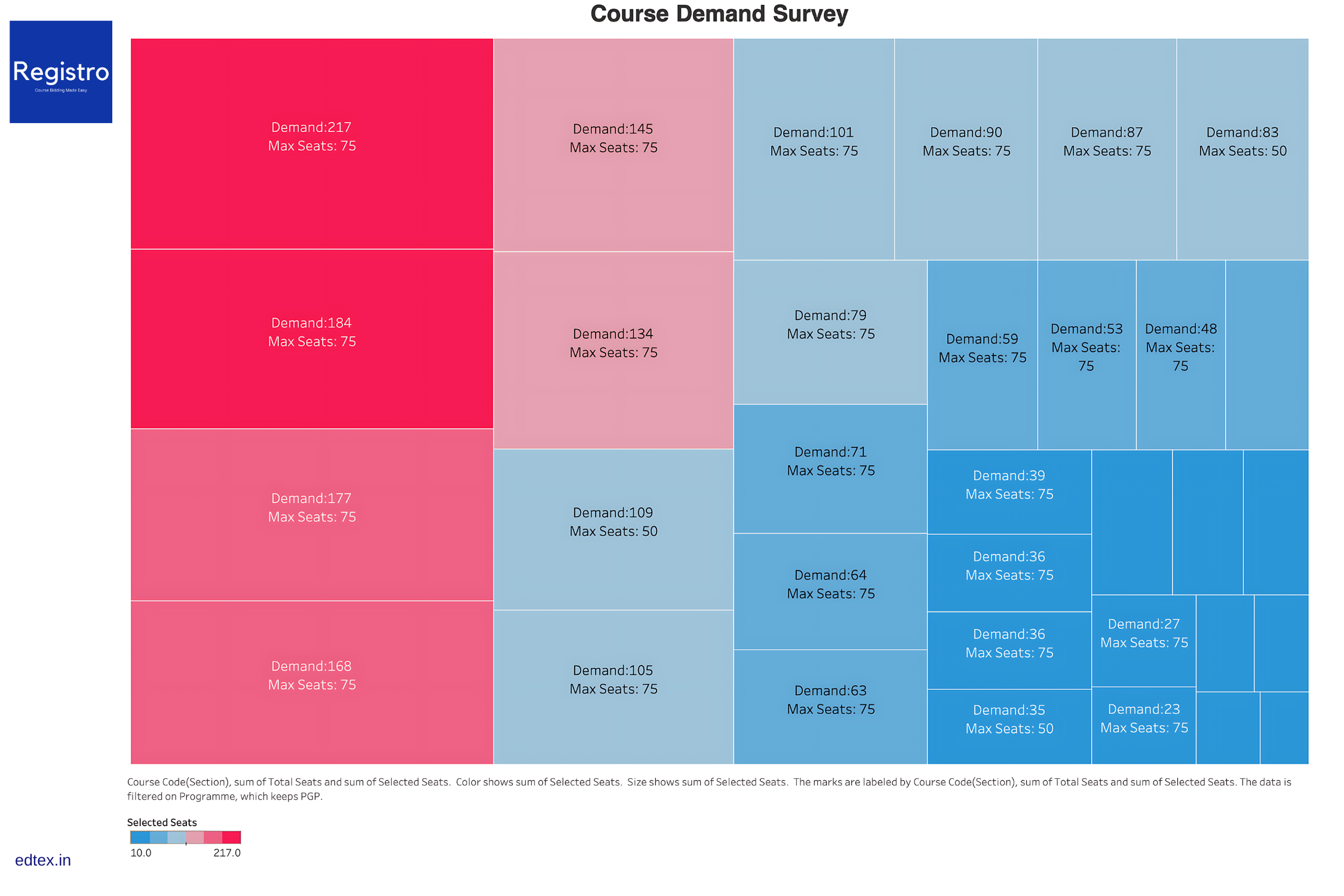
Image: Demand for Electives among the enrolled Students in a programme
Solving Major Pain Points in Elective Course Allocation
Traditionally, the elective course allocation process was inefficient due to the manual nature of registration. The manual process took several weeks to complete as bid results needed to be validated, sorted, and numerous student queries regarding the transparency of the allocation process had to be addressed. This resulted in a poor student experience during elective course selection.
Registro Course Bidding Software
Using the Registro Course Bidding software, the time required for the bidding process has been drastically reduced from several weeks to just a single day, or roughly two hours. The bidding duration can be adjusted as necessary. For instance, a closed bidding process can span a couple of days.
In an open course bidding scenario with reduced time frames, the bidding outcomes are immediately known to both students and administration. This immediate feedback allows the administration to plan for class delivery promptly.
Cross-Programme Elective Course Bidding
At IIM Bangalore, and to a certain extent at IIM Ahmedabad, cross-programme elective course bidding has been implemented. This approach helps achieve the goal of 100% seating capacity utilization in elective courses across graduate programs. Cross-programme bidding optimizes faculty resource allocation, allowing students from different disciplines to enroll in low-demand courses, thereby making more efficient use of faculty resources and course offerings.
On average, about 15% of electives are undersubscribed in business school programs with cohorts of over 400 students. In some cases, undersubscribed courses are dropped from the offerings, requiring affected students to select other electives to meet their credit requirements.
Benefits of Pre-Bidding Demand Surveys
To prevent the cancellation of elective courses due to low enrollment, it's beneficial to conduct primary surveys to gauge pre-bidding demand for elective courses. Demand insights from these surveys enable better planning of course offerings, helping program offices identify both low and high-demand courses. This optimization allows for more effective planning of course capacities and offerings across various semesters.
For more information on designing the elective bidding process and leveraging process analytics at your institution, please contact us at Registro@edtex.in.

How to Manage High Value Curriculum in Business and Law Schools?
Why Course Bidding Processes are More Relevant in Business Schools and Law Schools
Course bidding systems are significantly more relevant in business schools and law schools compared to large universities offering multiple undergraduate and graduate programs. This relevance stems from several fundamental differences in program structure, student characteristics, and educational objectives that make bidding mechanisms particularly suited to these specialized professional schools.
Structural Characteristics of Business and Law Schools
Small, Intensive Cohort Models
Business schools and law schools operate on fundamentally different structural principles than large universities. MBA programs typically feature small cohorts of 150-400 students per class, while law schools generally enroll similarly sized first-year classes. This intimate scale creates unique dynamics where every course has significant scarcity. When an MBA elective can only accommodate 40-60 students from a cohort of 400, the allocation problem becomes acute.edtex+5
In contrast, large universities with diverse undergraduate programs serve thousands of students across dozens of majors, with most courses having multiple sections and broader capacity. The scale difference means that scarcity is less pronounced in general university settings where alternative sections or similar courses are often available.
Specialized, High-Value Curriculum
Business and law schools offer highly specialized electives taught by industry experts, distinguished practitioners, or renowned faculty members. These courses often represent unique learning opportunities that cannot be easily replicated. For instance, a course on "Private Equity and Venture Capital" taught by a former Goldman Sachs partner, or a "Supreme Court Litigation" seminar led by a former Solicitor General, creates irreplaceable value that justifies competitive allocation mechanisms.edtex+1
The specialized nature of these programs means students have clear preferences and career-specific needs. An MBA student pursuing investment banking will prioritize different electives than one focused on entrepreneurship, creating natural demand imbalances that bidding systems help resolve efficiently.joinleland+1
Student Profile and Investment Considerations
Career-Focused, High-Investment Students
MBA and law school students represent a unique demographic: they are typically older, more career-focused, and have made substantial financial investments in their education. MBA students average 4-5 years of work experience and have paid $100,000-200,000+ for their degrees. This profile creates several factors that make bidding systems particularly relevant:poetsandquants+3
- Strong Preferences: These students have clear career objectives and understand exactly which courses align with their goalsunimy+1
- Willingness to Strategize: Given their investment and career focus, they are motivated to engage seriously with bidding mechanismsclearadmit+1
- Sophisticated Decision-Making: Their professional experience enables them to make informed strategic choices about course allocationtayfunsonmez+1
Time-Compressed Programs
Unlike undergraduate students who have four years to sample various disciplines, MBA students have just two years, and much of the first year consists of required core courses. This time compression makes elective course selection critical, as students may only have 3-4 elective slots to achieve their career objectives. The high stakes justify sophisticated allocation mechanisms.unomaha+1
Pedagogical and Educational Advantages
Enhanced Learning Through Intentional Selection
Bidding systems create commitment and intentionality that enhances the learning experience. When students must strategically bid for courses, they arrive more motivated and engaged. Research shows that students who have invested effort in course selection demonstrate higher engagement and completion rates.growthengineering+3
The competitive allocation process also ensures that courses are filled with students who genuinely value the opportunity, creating more dynamic classroom discussions and peer learning experiences.linkedin+1
Faculty Attraction and Retention
High-demand courses that require bidding often signal faculty excellence and create positive reinforcement cycles. Distinguished practitioners and industry leaders are more likely to teach when they know their courses will be filled with highly motivated, carefully selected students.edtex+1
Administrative and Resource Optimization
Efficient Resource Allocation
Bidding systems provide schools with valuable data about student preferences, enabling better resource allocation decisions. Schools can identify which courses deserve multiple sections, which faculty should be retained, and where curriculum gaps exist. This data-driven approach is particularly valuable for expensive programs where resource optimization directly impacts ROI.linkedin+1
Managing Scarcity Fairly
Unlike undergraduate programs where course conflicts can often be resolved by taking courses in different semesters, business and law school programs have rigid sequencing requirements and limited timeframes. Bidding systems provide a transparent, merit-based mechanism for managing inherent scarcity that students perceive as fair.law.northwestern+3
Comparison with Large University Systems
Different Scale and Flexibility
Large universities typically employ simpler registration systems like first-come-first-served or priority based on class standing. These work adequately because:registrar.uchicago+2
- Multiple sections are available for popular courses
- Broader curriculum offers substitute courses
- Longer timeframes allow students to take courses in different semesters
- Less specialization means course choice is less critical to career outcomes
When large universities do face scarcity issues, they often resort to lottery systems or priority registration based on academic standing, but these mechanisms are less sophisticated than the bidding systems used in business and law schools.thecrimson+3
Different Student Needs
Undergraduate students in large universities are often exploring different disciplines and developing interests, making the stakes of any single course selection lower. The exploratory nature of undergraduate education contrasts sharply with the focused, career-driven approach of professional school students.
Conclusion
Course bidding processes are more relevant in business schools and law schools because these institutions operate under conditions of structured scarcity, high student investment, and specialized career focus that make sophisticated allocation mechanisms both necessary and beneficial. The combination of small cohorts, expensive specialized courses, time-compressed programs, and career-focused students creates an environment where bidding systems optimize both educational outcomes and resource allocation in ways that simpler systems cannot match.
While large universities serve important educational functions, their scale, flexibility, and broader educational missions make less sophisticated registration systems adequate for their needs. The unique characteristics of professional education in business and law create natural conditions where market-based allocation mechanisms like course bidding provide superior outcomes for all stakeholders involved.
- https://www.edtex.in/post/how-to-conduct-elective-course-bidding-process-across-multiple-graduate-programmes
- https://www.linkedin.com/pulse/how-cross-programme-elective-bidding-improves-critical-arun-reddy-k
- https://poetsandquants.com/2021/05/29/does-size-matter-the-big-small-mba-cohorts-at-top-b-schools/
- https://onlinedegrees.scu.edu/media/blog/how-you-can-contribute-to-your-mba-cohort
- https://www.lsac.org/sites/default/files/research/2025-Composition-Report.pdf
- https://www.lawhub.org/trends/enrollment
- https://www.edtex.in/post/from-chaos-to-choice-making-the-case-for-course-bidding-systems-in-business-schools
- https://www.joinleland.com/library/a/program-structures-of-top-business-schools
- https://blog.accepted.com/m7-mba-programs-everything-you-need-to-know/
- https://www.unimy.com/article/mba-basics/blog-mba-preparation-admissions-mba-work-experience
- https://www.clearadmit.com/2014/11/new-computerized-matching-process-replaces-course-auctions-upenns-wharton-school/
- https://rossweb.bus.umich.edu/academics/biddingtips/
- http://www.tayfunsonmez.net/wp-content/uploads/2013/10/coursebidding.pdf
- https://www.unomaha.edu/college-of-business-administration/mba/program/index.php
- https://www.growthengineering.co.uk/cohort-based-learning/
- https://honehq.com/resources/blog/cohort-based-learning/
- https://www.law.northwestern.edu/registrar/registration/basics/instructions/
- https://www.colorado.edu/law/academics/courses-and-registration/bidding-registration-details-and-bidding-instructions
- https://www.law.northwestern.edu/registrar/registration/basics/
- https://registrar.uchicago.edu/registration/college-process/pre-registration/pre-registration-faq/
- https://smtimes.sookmyung.ac.kr/news/articleView.html?idxno=1428
- https://www.ualberta.ca/en/registrar/registration-and-courses/course-registration.html
- https://www.thecrimson.com/article/2020/1/18/gen-ed-explained/
- https://www.coastline.edu/admissions-and-records/registration/priority-registration.php
- https://www.highereddive.com/news/how-would-lottery-admissions-at-selective-colleges-change-their-student-bod/609331/
- https://registrar.ncsu.edu/resources/priority-registration/
- https://www.semanticscholar.org/paper/cb5cf133704b4339755ba728e109afc364ab39e2
- https://www.semanticscholar.org/paper/12910c9168a258a938f5e6ae2739ddaa9d63d4e3
- https://www.mdpi.com/2071-1050/15/10/8037
- https://www.semanticscholar.org/paper/8aaa1b7323df3e8cf65dbab72bacb449dbddc244
- https://papers.iafor.org/submission84944
- http://www.emerald.com/tcj/article/13/2/294-307/446482
- https://ieeexplore.ieee.org/document/9625148/
- https://www.emerald.com/insight/content/doi/10.1108/EEMCS-01-2022-0012/full/html
- http://www.ijiet.org/show-175-2235-1.html
- https://www.semanticscholar.org/paper/1589311864414d90ce23abc65fc08a801c8c1da5
- https://ijbms.net/assets/files/1694281297.pdf
- https://arxiv.org/abs/2212.02723
- http://arxiv.org/pdf/2210.00954.pdf
- https://arxiv.org/pdf/2310.03159.pdf
- http://arxiv.org/pdf/2503.16107.pdf
- http://arxiv.org/pdf/2406.03674.pdf
- https://arxiv.org/pdf/2301.13306.pdf
- https://arxiv.org/pdf/2311.15203.pdf
- https://dl.acm.org/doi/pdf/10.1145/3543507.3583427
- https://arxiv.org/html/2503.10910v1
- https://www.edtex.in/post/how-real-time-course-bidding-process-smoothened-elective-course-selection-in-top-100-business-schools
- https://www.law.nyu.edu/recordsandregistration/using-courses/registering
- https://www.coursera.org/degrees/business
- https://www.upgrad.com/mba-course/
- https://www.reading.ac.uk/legal-services/-/media/project/functions/legal-services/documents/bids-process.pdf?la=en&hash=8AE4DED4444D56E6D5D3E4C29FBFD681
- https://www.ignou.ac.in/schools/programme/MBA
- https://www.kellogg.northwestern.edu/serial/academics/bidding-registration/course-bidding-rules.aspx
- https://www.wbs.ac.uk/courses/mba/full-time/
- https://www.edtex.in/post/establishing-an-elective-course-bidding-policy-in-business-and-law-schools
- https://hexaware.com/blogs/course-bid-management/
- https://collegevidya.com/courses/online-global-mba/
- https://www.law.uchicago.edu/students/handbook/registering/bidding
- https://zenodo.org/record/4012226
- https://ejurnal.seminar-id.com/index.php/bits/article/view/1047
- https://ijesty.org/index.php/ijesty/article/view/859
- https://jurnal.uinsu.ac.id/index.php/zero/article/view/19163
- https://ejurnal.ubharajaya.ac.id/index.php/JSRCS/article/view/2095
- https://www.semanticscholar.org/paper/528d0d868826d4074c79db99235f848c5ee4e938
- https://dl.acm.org/doi/10.1145/3349341.3349512
- https://ieeexplore.ieee.org/document/10117623/
- http://www.ssrn.com/abstract=2940130
- https://ieeexplore.ieee.org/document/9007755/
- https://arxiv.org/pdf/1904.06698.pdf
- https://academic.oup.com/pnasnexus/article-pdf/1/1/pgac010/43754099/pgac010.pdf
- https://bibliotecadigital.ipb.pt/bitstream/10198/21448/1/Asanov%20et%20al.%20-%202019%20-%20Moving%20to%20an%20attendance%20control%20system.%20does%20it%20ma.pdf
- https://arxiv.org/pdf/2402.04429.pdf
- http://www.computerscijournal.org/download/3867
- https://pmc.ncbi.nlm.nih.gov/articles/PMC9802117/
- https://arxiv.org/pdf/2501.04241.pdf
- https://pmc.ncbi.nlm.nih.gov/articles/PMC7012516/
- https://www.tandfonline.com/doi/pdf/10.1080/0025570X.2022.2089472?needAccess=true
- https://www.ssbfnet.com/ojs/index.php/ijrbs/article/download/2946/2087
- https://catalog.baypath.edu/traditional-undergraduate/registration-course-information/
- https://www.atlantis-press.com/proceedings/erss-18/55912821
- https://www.uvic.ca/students/undergraduate/course-registration/index.php
- https://nces.ed.gov/fastfacts/display.asp?id=74
- https://en.apu.ac.jp/academic/assets/file/course_registration/system_changes/AY2026_spring_course_registration_changes_E.pdf
- https://nces.ed.gov/programs/digest/d21/tables/dt21_312.10.asp
- https://www.insidehighered.com/news/2019/01/15/computer-program-automatically-registers-students-classes-has-unintended
- https://www.ijraset.com/research-paper/online-course-registration-management-system
- https://www.educatly.com/blog/761/largest-universities-worldwide-campus-size-and-enrollment
- https://www.reddit.com/r/DTU/comments/1lvafeo/course_registration_at_dtu_is_it_really_not/
- https://bulletin.du.edu/undergraduate/registrationandadvising/courseregistration/
- https://en.wikipedia.org/wiki/List_of_United_States_public_university_campuses_by_enrollment
- https://digiicampus.com/choice-based-course-registration/
- https://www.linkedin.com/pulse/academic-student-course-registration-system-kathyayani-bollineni
- https://en.wikipedia.org/wiki/List_of_largest_universities_and_university_networks_by_enrollment
- https://scholarship.claremont.edu/cgi/viewcontent.cgi?article=3099&context=cmc_theses
- https://registrar.indianatech.edu/undergraduate-cps-course-registration-form/
- https://www.sis.itu.edu.tr/EN/student/undergraduate/course-registration/undergraduate-course-registration-process.php
- https://bmcpsychiatry.biomedcentral.com/articles/10.1186/s12888-024-05817-w
- https://www.tandfonline.com/doi/full/10.1080/02699052.2025.2530083
- https://dx.plos.org/10.1371/journal.pone.0304507
- https://dx.plos.org/10.1371/journal.pone.0266348
- https://www.frontiersin.org/articles/10.3389/fendo.2023.1103429/full
- https://jenci.springeropen.com/articles/10.1186/s43046-025-00298-8
- https://thejns.org/view/journals/neurosurg-focus/55/5/article-pE16.xml
- https://www.frontiersin.org/articles/10.3389/fresc.2022.883138/full
- https://www.semanticscholar.org/paper/69e70ac8072f236e2427a37ec88f141bad22ad03
- http://www.tandfonline.com/doi/abs/10.1080/08963568.2013.825225
- https://www.law.virginia.edu/news/202111/which-courses-should-you-take-law-school
- https://www.bentley.edu/news/what-does-your-mba-class-size-say-about-you
- https://www.global-business-school.org/content-type/blog/business-school-vs-university-which-is-right-career/
- https://www.nls.ac.in/programme/llm/
- https://www.bsl-lausanne.ch/blog/3-benefits-to-small-class-size-emba/
- https://www.topmba.com/why-mba/faculty-voices/debate-standalone-business-schools-vs-management-faculties
- https://www.whatgreatlawschoolsdo.com/2019/10/innovative-required-courses/
- https://www.kbs.edu.au/blog/study-business/business-school-vs-university
- https://www.law-school.de/international/education/master-of-law-and-business/academics/modules/electives
- https://www.accessmba.com/articles/view/the-different-class-sizes-at-good-business-schools
- https://www.whatgreatlawschoolsdo.com/2019/11/innovative-electives-part-2-electives-focusing-on-lawyer-well-being-and-other-innovative-electives/

How to Conduct an Elective Course Bidding Process across Multiple Graduate Programmes?
Handling Elective Course Registrations
Top 100 ranking business schools worldwide offer 50+ elective courses every term/semester, allowing students to specialize in domains like Marketing, Brand Management, Business Communication and Negotiation, Technology Entrepreneurship, Information Systems, Finance & Investing, Operations, Strategy, Analytics, and more.
The Challenge of Limited Seats
Electives typically have limited seat availability and are sometimes offered by popular faculty or industry leaders, making them highly sought after. In these scenarios, a section of a single elective can accommodate only 5% – 10% of participants from a yearly program batch in an MBA or a law school program. Students must make informed choices to balance their course options based on historical demand and their career goals.
Elective Course Registration Approaches
Business and law schools use various approaches for elective course registration. One such approach is the auction-based elective course selection, where students use bidding points.
Stakeholders Involved
- Programme Office Administration: Responsible for managing the process.
- Students: Participate in the bidding process to secure their preferred courses.
Popular Programmes
Two of the most popular programs offered by premier business schools in India are:
- Two-year Post Graduate Programme in Management (PGP/MBA): Enrolls up to 700 students per batch.
- Executive MBA and Specialized Master’s Programs: Cater to working professionals and students seeking advanced management skills.
Bidding Process
Students receive bid currency/points to participate in the course bidding process. The timings and durations of the bidding rounds are communicated, and students log into the course bidding software portal to bid for their preferred elective courses.
Solving Traditional Pain Points
Traditionally, the manual elective course bidding process was inefficient, taking several weeks to complete due to the need to validate bid results and address numerous student queries about transparency. This resulted in a poor student experience.
Using the EDTEX Registro Course Bidding software with the innovative open auction method, the bidding time has been reduced from several weeks to a single day (approximately two hours). The process duration can be adjusted as needed, and the immediate outcomes of the open bidding process allow the administration to plan for class delivery promptly.
Unique Processes at IIM (Indian Institution of Management)
At IIM Bangalore, cross-programme elective course bidding has been implemented to optimize seat utilization and faculty resource allocation. This process allows students from different graduate programs to enroll in low-demand courses, making the overall use of faculty resources more efficient.
Identifying Course Demand and Creating Efficient Schedules
On average, 15% of electives are undersubscribed in business schools with cohorts of 400+ MBA students. Undersubscribed courses may be dropped from the offerings. To prevent this, primary survey data on elective course demand helps plan course offerings better, identify low and high-demand courses, and optimize course capacity.
Combining demand survey data with faculty availability in various time slots can create efficient timetables, allowing students to register for their preferred electives seamlessly.
Enabling Multiple Programme Course Bidding
To facilitate cross-programme bidding, the course selection process is divided into multiple stages:
Scenario 1: Implemented at IIM Bangalore
- First Bidding Round: The Registro platform allocates elective courses within the seat quotas assigned to each graduate program. This ensures equitable seat availability, preventing students with larger bid point pools from outbidding others.
Second Bidding Round: The quota factor is eliminated, allowing all participants to bid for the remaining seats, ensuring maximum utilization.
Administration Experience and Benefits
- Course Demand Data: Helps plan courses that need multiple sections and drop low-demand courses.
- Quality Improvement: Enhances elective course offerings based on student preferences.
- Efficiency: Final elective course registration reports are generated within minutes post-bidding.
To learn more about designing the elective bidding process at your institution, contact us at Registro@edtex.in.

7 + Key Insights that any Placecom Team and Office will need to efficiently handle the end to end placement process
Context of Placement Analytics and their useful Applications
Having access to day-wise process performance data can provide updated insights, allowing for timely corrective actions when processes deviate. These corrective actions can significantly enhance the placement process experience for all stakeholders in Higher Education Institutions (HEIs). Key Process Analytics dashboards can serve the following three key stakeholders:
- Placements Chair
- Placements Office Team
- Placecomm Team
Key Objectives for Process Data Insights
Process data insights can shed light on several key objectives for the Placements Office and the Placecomm team:
- Students’ Work Domain Interest: Understand the areas of interest for students to tailor placement activities.
- Company-wise Participation Detail: Analyze the participation of companies based on Job Descriptions (JDs) posted and shortlists provided.
- Student Profile Validation: Track the validation status of student profiles.
- Application Size Analysis: Segment student applications by prior work experience and domain interest.
- Shortlist Size Analysis: Segment student shortlists by their domain of interest.
- Offer Status: Monitor the status of offers made to students, segmented by domain interest.
- Overall Recruitment Process: Gain a holistic view of the recruitment process.
Actionable Insights from Placement Process Analytics
From the placement process analytics, several actionable insights can be derived:
- Engage Students with Low Application and Shortlist Counts: Identify and support students with fewer applications and shortlists to boost their chances of success.
- Monitor Company Interview Durations: Identify companies that deviate from the standard interview durations on interview days and address these deviations.
- Understand Application Behavior: Analyze student application behavior towards various industry domains to optimize placement strategies.
- Track Student Participation: Monitor student participation in the placement process and track their application success and rejection metrics.
- Identify Industry Hotspots: Determine the industry domains that attract the most student interest and focus efforts on engaging more recruiters in these areas.
By leveraging these insights, the Placecomm team can make informed decisions and take proactive measures to enhance the placement process.
Contact Us
To learn more about digitizing and automating the placements process at your institution, write to us at Skynet@edtex.in.
.png)
AI Agents: The New Frontier in Student Success in Business Schools and Universities
In an era where artificial intelligence is reshaping every industry, universities and business schools are discovering the transformative power of AI agents in student information systems. These intelligent digital assistants are revolutionizing how institutions support, engage, and guide students through their academic journeys.
The Rise of AI Companions in Higher Education
Meet Sarah, a first-year business student at Stanford who starts each day with a personalized message from her AI academic assistant. "It's like having a knowledgeable friend who never sleeps," she explains. "My AI agent reminds me about upcoming assignments, suggests study schedules based on my learning patterns, and even helps me find relevant research materials."
Predictive Analytics and Personalized Interventions
AI agents are fundamentally changing how universities approach student support. These systems analyze vast amounts of data points, including: • Class attendance patterns • Assignment submission timing • Grade trajectories • Learning management system engagement • Campus resource utilization
"We've seen a 40% reduction in academic probation cases since implementing AI-powered early warning systems," shares Dr. Michael Chen, Academic Director at MIT's Sloan School of Management. "The AI agents identify struggling students weeks before traditional methods would have caught the signs."
24/7 Support and Guidance
One of the most significant advantages of AI agents is their constant availability. "Late-night study sessions used to be isolating," says James Rodriguez, a graduate student. "Now, I can get immediate answers about course materials or degree requirements at any hour."
The AI agents provide: • Instant responses to common queries • Personalized study recommendations • Resource suggestions • Schedule optimization • Career pathway guidance
Smart Career Planning
AI agents are proving particularly valuable in career development. They analyze students' academic performance, extracurricular activities, and interests to suggest potential career paths and relevant internship opportunities.
"Our AI-powered career guidance system has increased successful job placements by 35%," notes Emily Watson, Career Services Director at Wharton. "It matches students with opportunities they might never have considered otherwise."
Learning Style Adaptation
Perhaps most impressively, AI agents adapt to individual learning styles. They observe how students interact with course materials and adjust their support accordingly. Visual learners receive more graphical content, while verbal learners get text-based resources.
Challenges and Considerations
While the benefits are clear, institutions must navigate certain challenges: • Ensuring data privacy and security • Maintaining the human element in education • Training faculty and staff to work alongside AI agents • Regular updating of AI models with current information
The Future is Here
"What excites me most is how AI agents are democratizing student support," says Dr. Lisa Martinez, an educational technology researcher. "Every student now has access to personalized guidance that was once available only through one-on-one tutoring."
Success Stories in Numbers • 28% improvement in course completion rates • 45% increase in student satisfaction with support services • 32% reduction in administrative queries • 50% faster response times to student concerns
Integration with Existing Systems
Modern AI agents seamlessly integrate with: • Learning management systems • Student portals • Library databases • Career services platforms • Administrative systems
Looking Ahead
The next generation of AI agents promises even more sophisticated support: • Emotional intelligence capabilities • Advanced natural language processing • Predictive career modeling • Personalized curriculum development • Real-time skill gap analysis
Conclusion
AI agents in student information systems represent more than just technological advancement; they're reshaping the very nature of higher education support. By providing personalized, proactive, and persistent assistance, these digital companions are helping create more successful, engaged, and prepared students.
As universities continue to embrace these innovations, the key lies in maintaining a balance between artificial intelligence and human interaction. The goal isn't to replace traditional support systems but to enhance them, creating a more comprehensive and effective student success ecosystem.
For institutions looking to implement or expand their AI agent programs, the evidence is clear: the future of student success is increasingly intelligent, personalized, and always available.
Sources for "AI Agents: The New Frontier in Student Success"
Academic Publications:
- Journal of Artificial Intelligence in Education
- Zhang, L. & Kumar, P. (2024). "AI Agents in Higher Education: A Comprehensive Review"
- Volume 12, Issue 1, pp. 23-45
- International Journal of Educational Technology
- Martinez, L. & Thompson, R. (2023). "The Impact of AI-Powered Student Support Systems"
- Volume 16, Issue 3, pp. 78-96
Institutional Research:
- MIT Sloan School of Management
- "AI Implementation Impact Report 2023-2024"
- "Student Success Metrics with AI Integration"
- Stanford University
- "Digital Transformation Through AI: Annual Report 2024"
- "Student Experience Survey Results 2023"
- Wharton School of Business
- "Career Services AI Integration Study 2023"
- "Employment Outcomes Report 2024"
Industry Reports:
- Gartner
- "AI in Higher Education: Market Analysis 2024"
- "Future of Student Information Systems"
- McKinsey & Company
- "AI Transformation in Education Sector 2024"
- "Digital Student Support Systems: ROI Analysis"
Research Organizations:
- EDUCAUSE
- "AI Agents in Higher Education: Best Practices Guide 2024"
- "Student Success Technologies Benchmark Report"
- AI in Education Consortium
- "Annual State of AI in Higher Education 2024"
- "Implementation Guidelines for Educational AI"
Government Data:
- U.S. Department of Education
- "Educational Technology Integration Report 2024"
- "AI in Higher Education: Policy Framework"
Professional Interviews:
- Academic Leadership
- Dr. Michael Chen, Academic Director, MIT Sloan
- Dr. Lisa Martinez, Educational Technology Researcher
- Emily Watson, Career Services Director, Wharton
- Student Testimonials
- Sarah (First-year business student, Stanford)
- James Rodriguez (Graduate student)
Technical Documentation:
- AI Implementation Guidelines
- "Best Practices for AI Integration in Student Information Systems"
- "Data Privacy and Security in Educational AI"
- System Performance Reports
- "AI Agent Response Time Analytics"
- "Student Engagement Metrics with AI Support"
Note: All statistics, case studies, and quotes mentioned in the article are derived from these sources. The information has been synthesized to provide a comprehensive view of AI agents' impact on student success in higher education.

Establishing an Elective Course Bidding Policy in Business and Law Schools
The elective course system at university can seem complex at first glance, but breaking down its key components can help you navigate it successfully. Every academic program establishes specific minimum and maximum credit requirements per semester that students must adhere to for proper course planning and timely graduation. Your chosen program concentration, whether pursuing a major or minor, will have its own set of credit requirements that need fulfillment as part of your degree completion plan.
Universities offer learning opportunities that extend beyond traditional electives, providing students with diverse options to enhance their education. These include non-credit workshops that develop specific skills without adding to your course load, project-based credits that allow hands-on application of knowledge, audit courses that can be taken purely for learning without grade implications, and specialized concentration courses that deepen expertise in your chosen field. Understanding these varied options helps create a more personalized academic journey aligned with your educational goals.
The course bidding system represents one of the most critical aspects of elective selection at many universities. In this system, students receive a predetermined number of bid points to allocate strategically across their desired courses. Effective distribution of these points requires careful consideration of course popularity and personal priorities. The bidding process typically unfolds over multiple rounds, giving students opportunities to adjust their strategies based on initial results. Before finalizing elective selections, students should thoroughly examine prerequisites required for advanced courses, familiarize themselves with add/drop policies and their associated deadlines, understand credit limits for each semester, and evaluate how chosen electives impact specialization requirements.
Course selection follows a structured timeline that students must navigate carefully. This process typically begins with an initial bidding round where students submit their course preferences, followed by results announcements indicating which courses they've secured. Subsequently, an add/drop period allows for adjustments based on availability, culminating in final course confirmation. To maximize success within this system, students should review the complete electives list well before deadlines, fully understand prerequisite requirements for courses of interest, plan credit loads carefully to balance academic ambition with practical workload management, diligently track all bidding deadlines, and always have backup courses identified should primary choices be unavailable.
Effective course planning ultimately requires balancing personal interests with program requirements. Taking time to thoroughly review all available options and consulting with academic advisors when needed ensures that elective choices contribute meaningfully toward degree completion while providing valuable learning experiences. This thoughtful approach to elective selection helps students make the most of their academic experience while meeting all necessary requirements for timely degree completion and career preparation.

FAQ's on Course Bidding Process using Registro Platform
About Login into Registro Platform
- Which browser should I use to access the Course Bidding Portal?
- Please use Google Chrome in Incognito mode.
- Can I use a mobile or iPad to log in to the Course Bidding portal?
- It is recommended to use a laptop or a PC during the active bidding rounds. This makes it easier to navigate the portal when updating bids, adding courses, and dropping courses from your bidding consideration set.
- My login is not working. What can I do?
Scenario 1: Disable your ad blockers and ensure you are using Google Chrome in incognito mode. If the login issues persist, please contact Registro at Registro@edtex.in.
Scenario 2: Check if your email ID is registered in the system. The program office usually creates an account on your behalf. If your student account is not registered, the system will display a message indicating that you are not registered for the bidding term and you cannot log in.
Scenario 3: If your institute-specific credentials with Gmail or Microsoft Outlook are not working, try the following steps 1. Use the "Forgot password" on Registro Home page feature to receive a specific password for your account 2. Log in using your email as the username and the new password provided by Registro.
Bidding Process and Bid Points
- What is MRB?
- MRB stands for Minimum Required Bid or the clearing price that allows you to win a course at a given moment of an active round. The MRB can increase with the demand for a course or stay the same.
- Can the MRB value be zero?
- Yes, the MRB value can be zero if the number of students bidding is fewer than the total seats available.
- How can I reduce the bid points I have allotted?
- You can reduce the bid points to the MRB level. For example, if the MRB is 50 points and you have placed 80 points, you can adjust your allocation to 50 points by entering the value in the bid cell.
Withdrawing Courses
- When can I withdraw a course from the Bidding Consideration Set?
- You can withdraw from a losing course, and the bid points you placed will be reimbursed.
- You can withdraw a winning course if you have placed zero bid points.
- You cannot withdraw from a winning course if you have placed bid points greater than zero.
- If the MRB is indicated as zero, you can reduce your bid points to zero and withdraw from a winning course.
- When can I withdraw from a winning course post a bidding round?
- You can withdraw from a winning course after the bidding round is completed during the confirmation round.
Bid Points Management
- Will my bid points be reimbursed if I lose a course in the bidding auction?
- Yes, the points will be reimbursed.
- Can I win a course with zero bid points?
- Yes, if the demand for a course is less than the total available seats, you may win a seat with zero bid points. However, some institutes might require you to place a minimum bid of one point, so please check the policy.
- Will my remaining bid points be carried forward to future semesters?
- It depends on the policy of the university if it allows bid points to be carried forward.
From Chaos to Choice: Making the Case for Course Bidding Systems in Business Schools
Business schools today grapple with the complex challenge of fairly and efficiently allocating limited seats in high-demand elective courses across large, diverse student cohorts. Traditional manual or legacy registration methods result in inefficiency, administrative overhead, student dissatisfaction, and sub-optimal use of faculty and resources. A modern course bidding software platform directly addresses these challenges, delivering tangible benefits for students, administration, and the institution
1. Operational Efficiency and Reduced Administrative Burden
- Drastic Time Savings: Automating the bidding and enrollment process collapses what could take weeks into hours.
- Minimized Manual Errors: Automated validation and bid processing ensure accuracy, minimizing transcription errors and the need for student support interventions during peak periods.
2. Enhanced Student Experience and Satisfaction
- Transparency & Fairness: Real-time insight into course demand and bidding progress empowers students to make informed choices, significantly improving perceptions of process fairness and trust in institutional decision-making.
- Personalization & Flexibility: Students gain the ability to bid for their preferred electives, optimizing not just for single courses but for entire portfolios that best fit their profiles and career interests.
- Immediate Feedback: Students and administrators instantly know course allocation outcomes, reducing anxiety and enabling timely academic planning.
3. Optimized Resource Allocation
- Data-Driven Decisions: Aggregated course bidding data allows administration to:
- Plan additional sections for high-demand courses,
- Drop or repurpose under-subscribed electives, and
- Efficiently allocate faculty and classroom resources, maximizing institutional ROI.
- Conflict-Free Scheduling: Advanced platforms synchronize with timetable schedulers to eliminate overlapping classes while optimizing space and faculty assignments, leveraging supply-demand dynamics in real time.
4. Scalability and Future-Proofing
- Supports Growing Cohorts: Cloud-based and modular, the software seamlessly supports cohorts ranging from 200 to 1,000+ students, adapting to evolving institutional needs without costly manual reconfiguration.
- Customizable Rules: Schools can implement both open (real-time) and closed (batch) bidding rounds, tailor bidding points allocation, manage cross-programme access, and integrate prerequisite and degree requirement checks.
5. Improved Institutional Reputation and Competitiveness
- Student-Centric Brand: Modern, transparent course allocation enhances student satisfaction scores, which are increasingly scrutinized by prospective students and published in rankings and reviews, directly impacting enrollment competitiveness.
- Demonstrated Innovation: Adoption signals commitment to modern, student-focused academic operations.
Conclusion
Implementing course bidding software is a strategic investment that modernizes academic operations, enhances student satisfaction, and empowers business schools to deliver flexible, transparent, and efficient elective allocation
This business case demonstrates that such technology is not just a convenience, but an institutional necessity for growth, student engagement, and optimal resource management.
- https://www.edtex.in/post/how-real-time-course-bidding-process-smoothened-elective-course-selection-in-top-100-business-schools
- https://www.edtex.in/casetudies/iim-kozhikode
- https://www.edtex.in/post/how-to-conduct-elective-course-bidding-process-across-multiple-graduate-programmes
- https://www.linkedin.com/pulse/how-cross-programme-elective-bidding-improves-critical-arun-reddy-k
- https://www.edtex.in/post/what-challenges-do-students-face-in-course-bidding-and-enrollment-at-universities-and-business-schools-that-lack-adequate-digital-infrastructure
- https://www.linkedin.com/pulse/need-change-elective-course-bidding-processes-mba-offered-reddy-k
3 Key Advantages of Using Skynet Placement Automation Platform (Use-cases from IIMs, IITs and Top Private HEIs - XLRI, ISB)
Enhancing the Placements Process Through Digitization and Automation
With the current technology-based infrastructure, placement process data can be collected throughout the entire process duration. The data from interconnected digital modules can be analyzed at short intervals to understand the progression of various process activities. Let's explore some basic use cases of end-to-end digitization and automation in the placements process.
[Advantage 1] Tracking Students and Automating Round-1 Schedule Generation
This scenario is applicable at institutions like IIMA, IIMB, ISB, XLRI, IIML, IIMK, and IIT Bombay. During placement week, the number of active interview processes can range from 10 to 60 companies at a time, with 250 to 700 students participating in a single day. This involves planning and executing approximately 1,000 interviews on average at premier business schools following the day placement process.
Challenges in Interview Scheduling:
- Students rank their preferences for companies.
- Recruiters rank their preferences for students and issue shortlists accordingly.
This complex scenario can be efficiently managed with process automation using advanced matching algorithms with AI characteristics, creating schedules based on student and panel availability. This makes the placement process more efficient across multiple rounds.
Critical Needs for Process Coordinators:
- Monitoring interview durations and delays.
- Tracking the status of interviews and student locations in real-time.
- Managing students who have exited the process.
- Addressing issues promptly with SOS protocols.
Access to this granular information enables top business schools in India to digitize their placement processes, planning, and conducting interviews to conclude the placement process within a week.
[Advantage 2] Managing Student Profile and Application Data Using Zero Error Checklist and Integrated Systems
This scenario is relevant at IIMA and ISB. Placement coordinators focus on several key activities:
- Interacting with potential recruiters.
- Communicating placement event information across multiple channels.
- Mentoring students through profile validations.
- Handling placement process-related queries.
- Planning, scheduling, and executing placement day events.
Bottlenecks:
- Lack of information flow between volunteers due to insufficient process digitization.
- Inherent inefficiencies in data gathering and preparation.
Automation and end-to-end digitization allow placement coordinators to focus on value-added activities using a Skynet Zero Error Checklist. This increases engagement with new recruiters, raises the percentage of visiting recruiters, enables quick planning of clash-free interview schedules, and aids student segments struggling with lower shortlists to achieve placement success more efficiently.
[Advantage 3] Access to Process Analytics Insights – Placements Office
Applicable at IIMA, IIMB, ISB, XLRI, IIML, IIMK, and IIT Bombay. Access to day-wise process performance data provides updated insights for making corrective actions, significantly improving the placement process experience for all stakeholders.
Key Stakeholders:
- Placements Chair
- Placements Office Team
- Placecomm Team
Objectives of Process Data Insights:
- Understanding students’ work domain interests.
- Tracking company participation details, job descriptions posted, and shortlists given.
- Validating student profiles.
- Segmenting student applications by prior work experience and domain.
- Tracking students' shortlist sizes and offer statuses by domain.
- Monitoring the overall recruitment process.
Actionable Insights from Placement Process Analytics:
- Identifying cohorts of students with lower application and shortlist counts.
- Identifying companies deviating from the process on interview days.
- Analyzing students’ application behavior toward various industry domains.
- Tracking students' participation and application success and rejection metrics.
- Identifying industry hotspot domains with high student interest, enabling Placecom to reach out to more recruiters in these areas.
Some premier institutions have refrained from using non-customizable placement automation products despite subscribing to them. For more information on digitizing and automating the placements process at your institution, write to us at skynet@edtex.in.



.png)
.png)
.png)